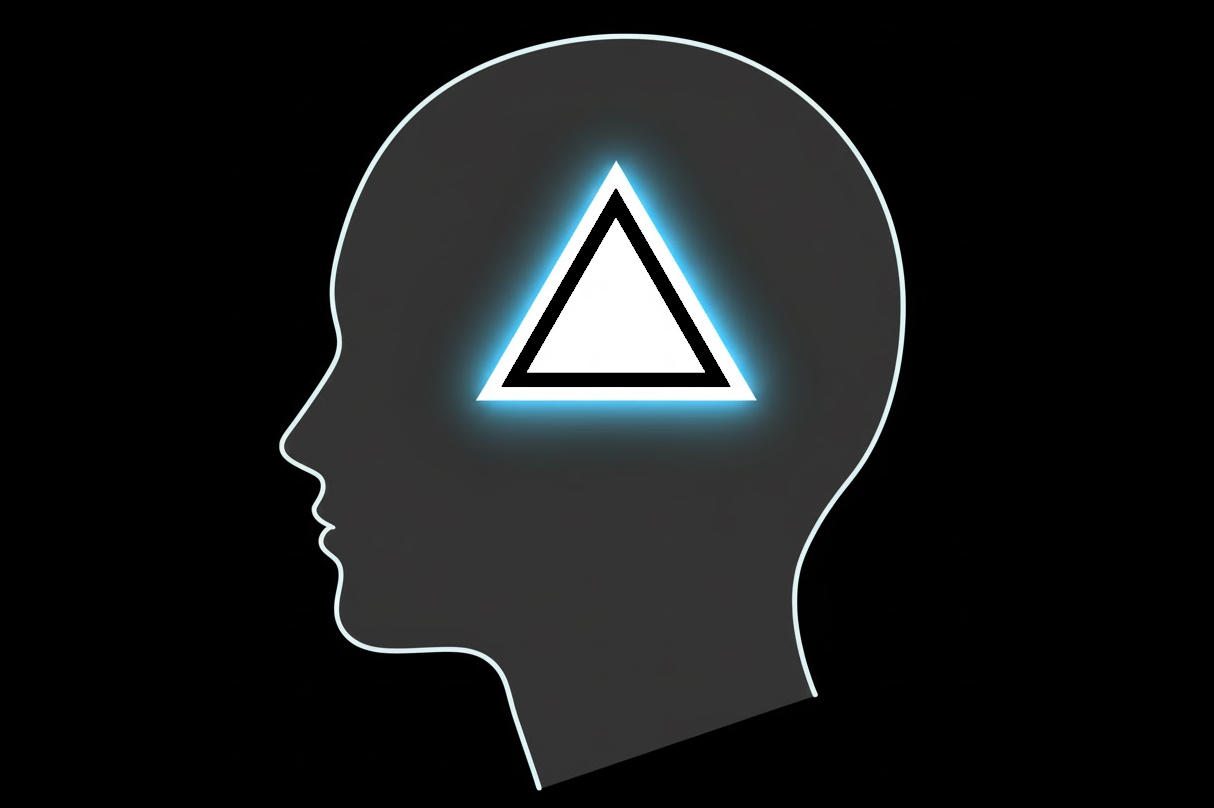
tl;dr – I point out a solution to Alex’s question about where (and what) the triangle in his mind’s eye actually is and explain the implications of this solution with respect to the nature of the self.
The Plea
In Alex O’Connor’s YouTube video How Does Consciousness Actually Exist?, he challenges the viewer to explain where the triangle he is visualizing in his mind’s eye is: “So please somebody, anybody tell me where this triangle is. I’m getting quite desperate.”. And offers a $50 reward to “anyone who can find the damn triangle.”
Alex contends that if you peer into someone’s brain while they are visualizing a triangle, there is nothing we can find in the brain that is the experience of that triangle. He acknowledges we can find evidence of the experience—such as neuronal firing patterns. But Alex argues that while the evidence may correlate with the visualization, it is not the experience itself.
Alex’s full plea:
“you can fully explain all of the brain activity that goes along with, correlates with, maybe even somehow causes conscious experience but that doesn’t make them the same thing. And I’m seeing a triangle. I’m not seeing a bunch of neurons firing. That might be what’s really going on in my brain but that’s not what I’m seeing in my head. So please somebody, anybody tell me where this triangle is. I’m getting quite desperate. $50 reward for anyone who can find the damn triangle.”
Most attempts at answering this question such as the triangle exists as “distributed information” or the triangle exists as a “computational process that represents the triangle” are woefully unsatisfying both intuitively and upon deeper inspection. But I won’t delve too much on those criticisms as O’Connor is already unconvinced by those arguments. What I really want to do is introduce a view that satisfies O’Connor’s question in a formal and testable way.
A Solution: Qualia Formalism & Physicalism
Qualia Formalism
Qualia Formalism is the view that “for any given conscious experience, there exists – in principle – a mathematical object isomorphic to its phenomenology” (Principia Qualia: 2016, Michael Edward Johnson, page 25). In other words, for any conscious experience, the entirety of the experience can be mapped and fully described by a mathematical object. At first this claim may seem a bit outlandish since subjective experience is rarely considered to be something one can investigate with mathematical rigor. But this is the result of the greatest mistake of the enlightenment: conflating subjective experience with subjectivity and consequently exiling both from the domain of science. While subjectivity is certainly antithetical to the scientific method, the structure of subjective experience itself can be studied rigorously. A wonderful example is the CIELAB color space, which is the mapping of phenomenal color in perceptual space. Qualia Formalism asserts that this kind of modeling is possible with all aspects of conscious experience.
Physicalism
Physicalism states that “consciousness is what certain physical processes feel like from the inside” (Principia Qualia, page 60). In this view consciousness does not need to emerge from anything, but instead is always present and the content and character of consciousness is the direct result of the physical processes corresponding to that qualia. This idea sounds like Panpsychism (“consciousness is everywhere”), but it is distinct and has more explanatory power. Physicalism makes possible specific and testable claims of the relationship between physical states and experience for example. Questions like “how can there be distinct selves if consciousness is ‘everywhere’” can be addressed rigorously and promising solutions exist. More on this later.
For the sake of answering this question (“where is the triangle”), let us assume that the electromagnetic field (as Susan Pockett and Michael McFadden suggest) is the field responsible for experience; the entirety of the content and character of an experience is determined by the state of the EM field that makes up that experience.
The Triangle
If this flavor of Physicalism (let’s call it EM-Physicalism) is true, the triangle you are experiencing exists inside the brain as a state of the EM field. If we were to peer inside your brain while you visualized a triangle with your eyes closed, we would find that the mathematical description of the state of the EM field (a 3D vector field) inside your brain corresponds exactly to your experience of a triangle. An EM state that is the experience of a triangle perhaps may look like this field: YouTube: Triangle in the EM Field. This demo is likely naive because I assume that the vector field’s euclidean geometry maps exactly to the euclidean geometry of the experience but nonetheless I think this example is illustrative.

So if Qualia Formalism, Physicalism (as defined by Johnson in PQ), and the EM Theory of Consciousness are true, the neurons firing certainly would not be the same thing as the experience but the configuration of the EM field in Alex’s brain WOULD be the same thing as the experience. The mathematical object describing the EM field would perfectly and fully describe the experience and the EM field itself in that state would be that experience. One of the many purposes of the neurons in the brain is to manipulate the EM field to perform experiential processing (Qualia Computing).

This view has extraordinary explanatory power and its implications are radical. For example, it implies that if the EM field has this configuration anywhere in the universe then an experience of a triangle is happening there. This begs the question: why am I not experiencing the entirety of the universe’s EM field? Luckily, EM-Physicalism has an answer.
But what about the Self?
On the surface EM-Physicalism seems like Panpsychism in that it sidesteps the hard problem of consciousness but leaves a big question unanswered: how does a unified field of consciousness give rise to distinct minds? Alex asks in his interview with Sam Harris: “when a thought arises in my head, it isn’t arising in YOUR head…. so if the self is an illusion, then what is the thing that the thought like that can happen to that makes it such that you can have the thought but I can’t have your thought”. Alex cuts to the heart of the nature of the self by asking what the boundaries of consciousness are. What makes qualia happening in his field of awareness inaccessible to someone else’s field of awareness. Here it becomes clear that Panpsychism is trading the hard problem of consciousness for what we might call the “problem of distinct minds”. In the context of Physicalism, this is called the “Boundary Problem” (The Boundary Problem for Experiencing Subjects (Rosenberg 1998)) . But Physicalism, or at least EM-Physicalism, need not make this compromise because it offers an elegant solution to the Boundary Problem: Topological Segmentation.
Andrés from the Qualia Research Institute explains this beautifully in Topological Segmentation of the EM Field: A New Approach to the Boundary Problem of Consciousness. The tl;dr is that topological pockets in the electromagnetic field may explain the intersubjective boundaries that produce distinct minds. Topological pockets partition a field with hard, causally significant borders. If the EM field is a single god-mind then topological pockets in that field are partitioned mini-minds. This process is similar to Bernardo Kastrup’s idea of a person’s mind being a dissociated part of the cosmic mind. Andrés makes the case that these topological pockets are computationally useful and were recruited by evolution. One of the functions of the brain may be to pinch off a chunk of the EM field for computational purposes, creating a mini-mind in the process. I expand on this idea with my co-authors Andrés Gomez-Emilsson and Chris Percy in the article “The Electrostatic Brain: How a Web of Neurons Generates the World-Simulation that is You“. In that article we argue that these partitioned mini-minds were recruited by evolution to instantiate the real-time world simulation we inhabit and speculate on the potential mechanics of that simulation assuming EM-Physicalism is true.
For a more comprehensive overview of the philosophy of self from the Qualia Research Institute’s perspective, watch Andrés’ video Solving the Phenomenal Binding Problem: Topological Segmentation as the Correct Explanation Space. I encourage anyone interested in consciousness to seriously ponder the problem of distinct minds and to watch the video.
Acknowledgements
This work is heavily inspired by the work of Andrés Gómez Emilsson and the Qualia Research Institute, Chris Percy, Mike Johnson (Principia Qualia), Steven Lehar (Cartoon Epistemology and The Grand Illusion), Johnjoe McFadden and Susan Pockett (Electromagnetic Theories of Consciousness).
Leave a Reply